A Decision Framework for CIOs
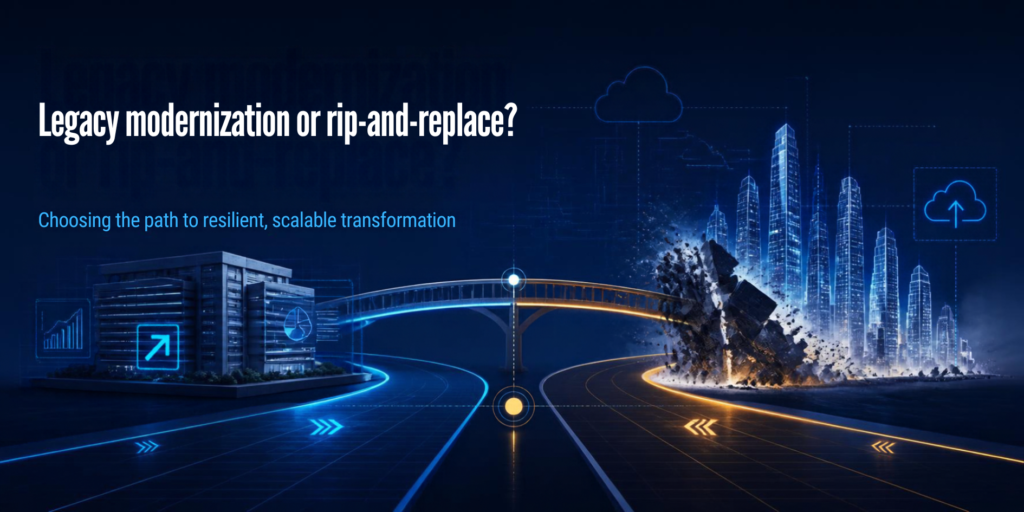
The question arrives on almost every CIO’s desk eventually: does this system get modernized, or does it get replaced? The instinct in boardrooms is often to frame this as a binary choice between cautious incrementalism and bold transformation, but that framing obscures a far more useful reality. There are at least seven distinct strategies between “leave it alone” and “rip it out,” and choosing the wrong one is more often the cause of transformation failure than choosing either extreme.
The Seven Strategies, Precisely Defined
The most widely used framework for this decision, often called the seven Rs, originated in cloud migration strategy work and has since been generalized to application modernization broadly. Understanding each option precisely, rather than treating “modernize” and “replace” as vague categories, is the first step to making a defensible decision.
Retain means keeping the system as-is and deliberately revisiting it later, rather than leaving it unchanged by default or neglect (Saigon Technology). This is a legitimate strategic choice for systems that work, carry low risk, and are not blocking other priorities, not merely a failure to decide.
Retire means decommissioning an application that no longer earns its keep while preserving any data that must be retained for legal or operational reasons (Saigon Technology). This is chronically underused; every enterprise IT estate carries applications nobody has had the mandate to formally shut down.
Rehost is the “lift and shift” approach, moving an application to new infrastructure, typically the cloud, with no code change (Saigon Technology; IBM). It is fast and low-risk but captures none of the architectural benefits of the platform it moves to.
Replatform, sometimes described as “lift, tinker, and shift,” makes targeted changes during the move, such as swapping a self-managed database for a managed cloud service, to capture some platform benefits without rewriting business logic (Saigon Technology).
Refactor improves the internal quality of the code itself, its readability, structure, and dependencies, without changing the application’s overall architecture (Saigon Technology).
Re-architect goes further, restructuring the application itself, most commonly by decomposing a monolith into microservices to enable independent scaling and deployment (Saigon Technology).
Rebuild and replace are the two true “rip-and-replace” options: rebuild means rewriting the application from scratch on the same conceptual footprint, while replace means substituting it entirely with a commercial off-the-shelf package or a SaaS subscription (Saigon Technology).
Why the Framework Matters More Than the Buzzword ?
The reason this framework matters is that “modernization” and “rip-and-replace” are not opposites on a spectrum; they are labels for clusters of these seven strategies applied inconsistently across an application portfolio. A single core banking transformation program might rehost its reporting layer, refactor its payments middleware, re-architect its customer-facing channels, and replace its general ledger outright, all within the same initiative. IDC’s global banking research illustrates the scale of this mixed decision-making: nearly three-quarters of banks still run on legacy core systems, yet 98 percent plan upgrades within three years, and 53 percent of large banks aim to move more than 40 percent of total workloads to the cloud (Fintech Singapore). No single one of the seven Rs describes that transition; it is a portfolio decision made application by application, and often module by module within a single application.
The global cloud infrastructure market underlying much of this modernization work is itself growing quickly, from roughly 752 billion US dollars in 2024 to a projected 2.39 trillion US dollars by 2030, driven substantially by AI and machine learning workloads that demand robust, elastic infrastructure (IBM). That growth curve is precisely why the decision framework matters more now than five years ago: the cost and complexity of getting the wrong strategy for the wrong application has risen alongside the range of options available.
A Practical Decision Sequence for CIOs
Rather than starting with “modernize or replace,” a more defensible sequence starts with three questions applied to each significant application or system in the portfolio.
First, does this system constrain the business, or does it simply run in the background?
IDC’s banking data found that 52 percent of banks reported legacy infrastructure imposing major restrictions on new digital product delivery, and 65 percent cited the absence of real-time processing as a key constraint (Fintech Singapore). Systems that actively constrain competitive capability deserve re-architecture, rebuild, or replace consideration. Systems that quietly do their job, without blocking anything strategic, are strong candidates for retain or, at most, rehost.
Second, is the constraint architectural or is it a packaging problem?
An application with sound underlying logic but poor code hygiene is a refactor candidate. An application whose entire architecture prevents the flexibility the business now needs, such as an inability to configure or launch new products quickly, cited by 49 percent of banks in the IDC research as a major issue, needs re-architecture or replacement, not refactoring (Fintech Singapore).
Third, for regulated Singapore enterprises, what does the target strategy imply for regulatory obligations?
Any strategy that involves moving workloads to a public cloud provider, whether through rehosting, replatforming, or full replacement with a SaaS product, triggers outsourcing obligations for financial institutions under MAS’s regulatory framework. MAS treats cloud services operated by external providers as a form of outsourcing and holds financial institutions ultimately responsible and accountable for maintaining effective oversight and governance of that relationship, no matter which of the seven Rs delivered the underlying system (MAS). This obligation does not diminish with a full replace decision; if anything, it intensifies, because a new SaaS platform introduces a new vendor relationship, a new data residency question, and a new set of controls to assess against the Technology Risk Management Guidelines (MAS).
The Portfolio View Beats the Single Decision
The organizations that get this right stop asking “should we modernize or replace” as a single enterprise-wide question. Banking executive teams show striking alignment on this point: 93 percent expressed willingness or full commitment to core system change (Fintech Singapore), yet the actual work ahead is not one decision but dozens, applied differently to the general ledger, the customer channel layer, the reporting stack, and the compliance systems that regulators will scrutinize regardless of which of the seven Rs delivered them.
For a CIO building the business case, the seven Rs framework does more than organize technical options. It gives the board a shared vocabulary for what is actually being proposed, application by application, and it forces an honest answer to the question that “rip-and-replace” as a slogan tends to skip: which systems genuinely need to be rebuilt from zero, and which merely need to be moved, tuned, or retired.