
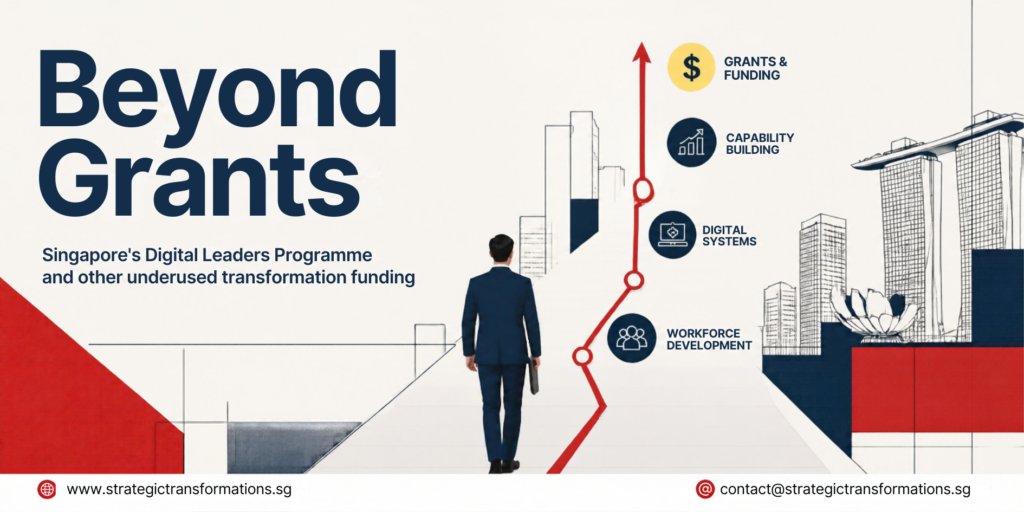
Most Singapore enterprises structure their grant conversations around the well-known trio of EDG, PSG, and MRA, and, from 30 September 2026, the consolidated EDGE Grant that succeeds them. But for organisations that have moved past basic digital adoption and are now building in-house digital and AI capability, hiring digital leadership talent, or preparing for deeper transformation, a smaller set of less-publicised schemes can matter more than the headline grants. This article looks at three of them: the IMDA Digital Leaders Programme, the Enterprise Development Grant’s sustainability track, and the broader Business Grants Portal ecosystem that many CIOs never fully explore.
The Digital Leaders Programme: Funding for Digitally Mature Companies
The Digital Leaders Programme (DLP), administered by the Infocomm Media Development Authority (IMDA), occupies a different niche from EDG, PSG, or EDGE. Rather than subsidising a specific software purchase or consultancy engagement, DLP is designed for digitally ambitious, non-ICT companies that already have basic digital processes in place and are ready to build in-house digital capability, not simply buy an off-the-shelf solution (Grants.sg, Digital Leaders Programme).
Launched in 2021, DLP supports companies across three areas: charting digital roadmaps to prioritise high-impact projects, hiring in-house digital teams (such as AI and machine learning engineers or digital product managers) to execute those plans, and embarking on projects that incorporate emerging technologies, particularly AI, for productivity and growth (Grants.sg, Digital Leaders Programme). In September 2025, IMDA announced an enhanced version of the programme, intensifying support for 2,000 local digitally mature enterprises over three years, structured around three pillars: uplifting leadership mindset through Tech Discovery Workshops and Playbooks, building confidence to design and deliver AI projects by tapping technology partners, and building internal, self-sustaining digital competencies through funding support for hiring in-house digital teams (Grants.sg, Digital Leaders Programme). As of the most recent published figures, more than 600 enterprises have benefited from DLP, with close to 50 supported specifically in recruiting digital teams and implementing AI projects (Grants.sg, Digital Leaders Programme).
Eligibility is narrower than the mass-market grants: applicants must be ACRA-registered, taxable, and operating in Singapore, with at least 30% local shareholding, must be non-ICT companies (this programme deliberately excludes technology vendors), and must already demonstrate basic digital maturity and clear ambition for larger-scale transformation (Grants.sg, Digital Leaders Programme). There is no standing online application form; interested companies express interest via IMDA’s Digital Transformation Community inquiry form or by emailing the DLP team directly, after which IMDA evaluates the company’s digital maturity and ambition before structuring a tailored engagement (Grants.sg, Digital Leaders Programme). This relationship-driven, milestone-based structure, rather than a fixed percentage co-funding rate published for public reference, is precisely why DLP is underused: it does not fit neatly into a “grant calculator” the way PSG or EDG does, and it requires a genuine conversation with IMDA rather than a self-service portal submission. For CIOs specifically trying to build an internal AI or digital engineering bench rather than simply purchasing AI tools, this is often a more strategically appropriate vehicle than the transactional co-funding grants, and boards should ask their transformation office whether DLP eligibility has even been assessed.
The Sustainability Track Inside EDG (and Soon, EDGE)
A second underused lever sits inside a scheme most CIOs already know: EDG’s sustainability-related project track. While EDG’s standard support rate for local SMEs is up to 50% of eligible costs, projects classified as sustainability-related receive an enhanced rate of up to 70% (Enterprise Singapore, EDG). This 20-percentage-point premium applies to costs across third-party consultancy fees, software and equipment, and internal manpower, the same qualifying cost categories as standard EDG projects, provided the project itself is framed and scoped around sustainability outcomes.
For enterprises running hybrid cloud or data centre consolidation programmes, energy efficiency reporting, or ESG data governance tooling as part of a broader digital transformation, framing these workstreams explicitly as sustainability projects, where genuinely applicable, can unlock a materially better funding rate than treating them as generic IT modernisation. Since EDG closes to new applications on 29 September 2026, and Sustainability is confirmed as one of the eight EDGE Grant business areas carrying forward into the new consolidated scheme, organisations should not assume this enhanced treatment for sustainability projects disappears; it is likely to persist in some form under EDGE, but the exact EDGE-specific sustainability rate should be verified on the Business Grants Portal once activity-level terms are published, since Enterprise Singapore itself notes that EDGE support levels are activity-specific rather than uniform (Grants.sg, EDGE Grant).
Don’t Overlook the Investment Allowance Route for Large Capital Projects
For enterprises undertaking large-scale automation or infrastructure investment, EDG has also carried a distinct capital allowance mechanism worth flagging separately from the co-funding grant itself: a 100% Investment Allowance for qualifying large-scale automation projects, with approved capital expenditure capped at S$10 million per project, applied net of any grant already received (Enterprise Singapore, EDG). This is a tax mechanism rather than a cash grant, and it is frequently missed by finance teams who focus exclusively on the co-funding percentage and overlook the parallel capital allowance treatment available for genuinely large automation or hybrid cloud infrastructure builds. Enterprises planning capital-intensive transformation projects should have their tax advisers assess this alongside any EDG or EDGE grant application, since the two mechanisms can be complementary rather than mutually exclusive.
Why These Get Overlooked, and How to Fix That Internally ?
The pattern across all three of these levers, DLP, the EDG sustainability premium, and the Investment Allowance, is that none of them show up in a simple grant comparison table the way PSG’s flat 50%-up-to-S$30,000 structure does. They require a scoping conversation, a classification judgment, or a direct relationship with the administering agency rather than a straightforward self-service portal application. That makes them easy for busy transformation offices to skip, even when they represent materially better economics than the default grant path.
The practical fix is procedural: before finalising the funding plan for any digital transformation, AI governance, or cybersecurity initiative above a meaningful budget threshold, the CIO or finance lead should explicitly ask three questions. Does this initiative involve hiring or building an in-house digital or AI team, in which case DLP eligibility should be assessed with IMDA directly? Does any component of this project have a genuine sustainability, energy efficiency, or ESG reporting dimension that could justify the enhanced EDG or EDGE sustainability rate? And is any part of this a large-scale capital investment in automation or infrastructure that could qualify for the Investment Allowance alongside, not instead of, a grant claim? Building these three questions into the standard transformation business case template, rather than defaulting to whichever grant is easiest to apply for online, is a low-cost governance change that can materially improve the economics of a transformation programme, particularly as Singapore’s grant architecture undergoes its biggest structural change in years with the shift from EDG, PSG, and MRA to the consolidated EDGE Grant from 30 September 2026 (Enterprise Singapore, EDGE Grant).